
What is a Digital Signature Certificate? Complete Guide for Indian Businesses (2026)
Every director filing on MCA21, every exporter on DGFT, every company submitting an Income Tax return needs one — yet most business owners still aren't clear on what a Digital Signature Certificate actually is, or why a simple OTP isn't enough. This guide settles all of that.
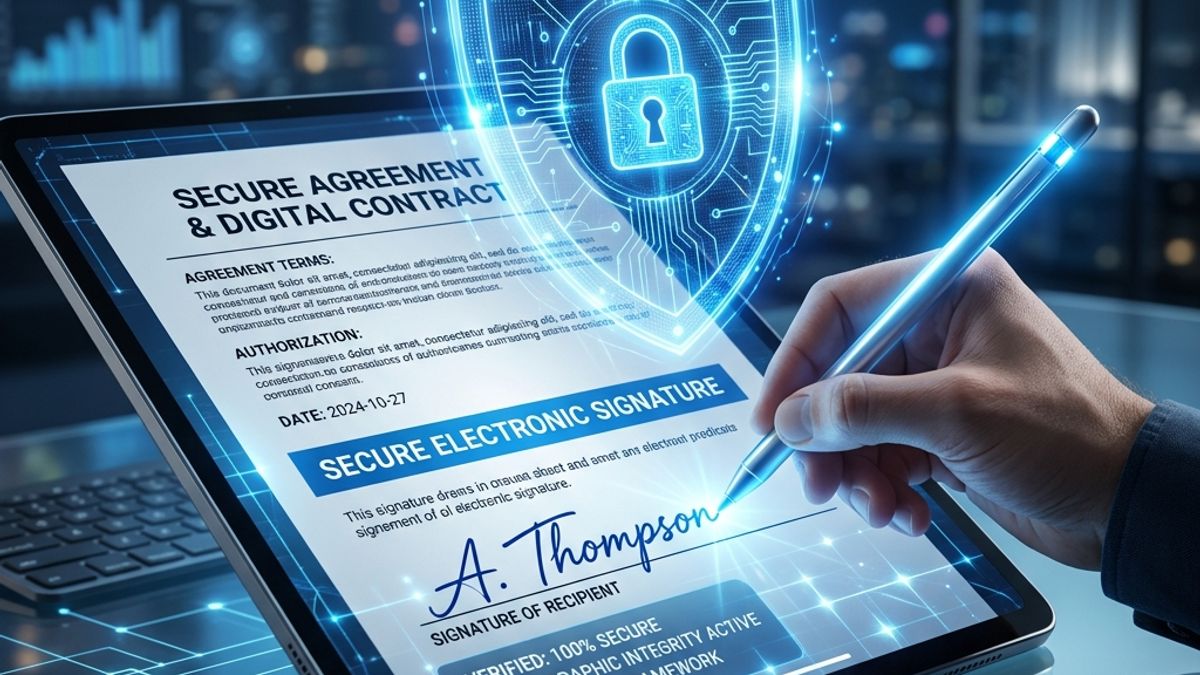
What is a Digital Signature Certificate?
A Digital Signature Certificate (DSC) is an electronic credential issued by a licensed Certifying Authority (CA) that proves your identity online and lets you sign digital documents with the same legal weight as a physical signature. Think of it as a digital passport: it contains your name, public key, the CA's details, and a validity period — all wrapped in a tamper-evident cryptographic envelope.
In practice, your DSC is stored on a USB crypto token (a small dongle similar to a pen drive). When you plug it into your computer and enter your PIN, you can sign government forms, e-tenders, filings, and documents — and the signed output can be verified by any portal to confirm it was genuinely you who signed it, and that nothing was altered afterward.
Legal Basis: The IT Act 2000
DSCs in India are governed by the Information Technology Act, 2000 (IT Act), specifically Sections 3, 5, and the Second Schedule. Key points:
- Section 3 provides that digital signatures shall be deemed secure and valid if authenticated using a system compliant with the Act's standards.
- Section 5 grants digital signatures the same legal recognition as handwritten signatures on any document.
- The Controller of Certifying Authorities (CCA) under the Ministry of Electronics & IT licenses CAs and oversees the PKI (Public Key Infrastructure) ecosystem.
- DSC-backed signatures on company filings with the MCA, tax filings with the IT Department, and customs filings on ICEGATE are all legally mandated and enforceable.
Only CAs licensed by the CCA can issue valid DSCs in India. As of 2026, major licensed CAs include eMudhra, Sify, NSDL, and others — Akham Digital is an authorised registration point for these CAs, meaning you apply through us, we verify your documents, and the certificate is issued the same day.
Who Needs a DSC?
The short answer: any individual or company that needs to file documents, submit bids, or sign applications on a central or state government portal in India. More specifically:
| Who | Why They Need It | Certificate Type |
|---|---|---|
| Company Directors / Partners | MCA21 filings (ROC, annual return, DIN) | Class 3 Individual |
| Chartered Accountants / CS | Signing audit reports, company filings | Class 3 Individual |
| Companies filing ITR (audit required) | Income Tax e-filing with DSC | Class 3 Organisation |
| Importers / Exporters | DGFT portal (IEC, MEIS, RODTEP claims) | DGFT DSC |
| Contractors / MSMEs | Government e-tenders (GeM, CPPP, state portals) | Class 3 Organisation |
| GST registrants (companies) | GST registration and filings | Class 3 Sign+Encrypt |
| IP applicants | Trademark and patent applications | Class 3 Individual |
| Customs brokers / freight agents | ICEGATE filings | Class 3 Individual |
Sole proprietors operating in most of these contexts also need an Individual DSC — there is no exemption based on business size.
DSC vs Aadhaar OTP e-Sign: The Critical Differences
Many people assume that since they can sign PDFs using an Aadhaar OTP, they don't need a DSC. This is a costly misconception. Here is how the two differ:
| Feature | Aadhaar OTP e-Sign | Class 3 DSC |
|---|---|---|
| Legal acceptance on MCA21 | No | Yes |
| Legal acceptance on DGFT | No | Yes (DGFT DSC) |
| Legal acceptance on Income Tax (company) | No | Yes |
| Accepted for e-tenders | No | Yes |
| Hardware-backed security | No (OTP only) | Yes (USB crypto token) |
| Non-repudiation | Partial | Full (CA-certified) |
| Works offline | No | Yes (token + PIN) |
| Valid for 1–2 years | No (per-session) | Yes |
Aadhaar OTP e-signing is convenient for personal agreements, bank documents, and some consumer portals. But for any mandatory government filing involving a company, an LLP, or an individual in a professional capacity, a Class 3 DSC is the legally required method.
Government Portals That Require DSC
India's digital governance infrastructure now runs on DSC authentication. Key portals include:
- MCA21 (mca.gov.in) — Company incorporation (SPICe+), annual filings, director appointments, LLP filings. Directors and authorised signatories must have Class 3 DSC.
- Income Tax Portal (incometax.gov.in) — Companies and audited entities must file ITR with DSC. Individuals filing voluntarily can use Aadhaar OTP, but companies cannot.
- GSTN (gst.gov.in) — New GST registration for companies requires a DSC. Amendments and some refund claims also need DSC authentication.
- DGFT (dgft.gov.in) — IEC-related filings, scrip applications, RODTEP and MEIS claims. DGFT has its own DSC variant that must be used — standard Class 3 is not accepted.
- ICEGATE (icegate.gov.in) — Customs bill of entry and shipping bill filings by importers, exporters, and customs brokers.
- GeM (gem.gov.in) and CPPP — Government e-marketplace bids and central procurement portal tenders.
- IP India (ipindia.gov.in) — Trademark and patent applications.
- NSWS (nsws.gov.in) — National Single Window System for business registrations and licences.
How a DSC Actually Works (Without the Jargon)
A DSC uses Public Key Infrastructure (PKI) — a system where every certificate holder has two mathematically linked keys: a private key (stored on your USB token, never leaves it) and a public key (shared with everyone, embedded in your certificate).
When you sign a document:
- The software creates a unique "hash" (fingerprint) of the document.
- Your USB token's private key encrypts that hash, creating the digital signature.
- Anyone can verify the signature using your public key — if the decrypted hash matches the document's current hash, the document is confirmed unaltered and genuinely signed by you.
If someone changes even a single character in the document after you've signed it, the hash won't match and the signature will show as invalid. This is why DSC-backed signatures are legally bulletproof — they detect tampering automatically.
Getting Your DSC: What It Takes
The process is fully online and takes less than an hour for individuals. Documents you need:
- PAN Card (mandatory)
- Aadhaar Card (for video verification)
- Passport-size photograph
- Active mobile number linked to Aadhaar
- Active email address
For companies: add an Authorisation Letter on letterhead and, for Pvt Ltd, a Board Resolution. Prices start at ₹2,500 for a 1-year Class 3 Individual DSC including the USB token and delivery. Organisation DSCs are the same price.
Get Your DSC Today — Fully Online, Same-Day Issuance
Authorised CA provider based in Mumbai. Class 3 DSC from ₹2,500. Documents via WhatsApp. Token delivered to your door.
Apply for DSC on WhatsApp
ICEGATE DSC Registration: Complete Customs & Advisory Guide (2026)
A complete operational guide to registering and updating Class 3 Digital Signature Certificates on the ICEGATE 2.0 customs portal for Indian exporters and importers.
How Foreign Nationals & NRIs Can Get a Class 3 DSC in India
Step-by-step documentation, apostille guidelines, and online video verification process for foreign directors, investors, and NRIs requiring an Indian DSC.
Troubleshooting USB Token Drivers: ePass2003, Watchdata & mToken Fixes
Comprehensive troubleshooting guide for token not detected errors, PIN lockouts, CSP initialization failures, and driver conflicts in Windows 11.